| Photonic Materials Technology Section (PMTS) |
 Photonic Materials Technology Section (PMTS)
Nano-Electronic Materials and Devices Laboratory
Photonic Materials Technology Section (PMTS)
Nano-Electronic Materials and Devices Laboratory
Transparent Conducting Electrodes
Transparent Conducting Electrodes (TCEs) are thin layers of materials that combine optical transparency with electrical conductivity. They are integral components in a variety of optoelectronic devices, such as touch screens, solar cells, light-emitting diodes (LEDs), and liquid crystal displays (LCDs). Common materials for TCEs include indium tin oxide (ITO), graphene, silver nanowires, and conductive polymers like PEDOT:PSS. We have developed ZnO based low-cost and environment friendly TCOs by doping ZnO with n-types dopants such as Al, Si and Ga, which showed performance comparable to commercially available ITO electrodes.
Si doped ZnO thin films- Quantum corrections to conductivity
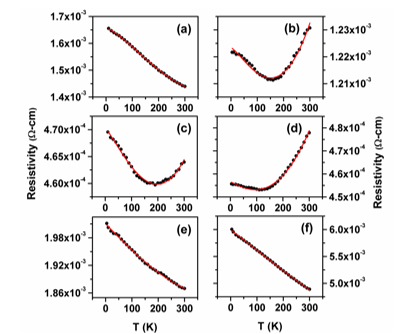
We have grown Si doped ZnO thin films with Si concentration in the range from 0.5 to 5.8% using sequential pulsed laser deposition. The lowest resistivity obtained was ~ 4.6×10⁻⁴ Ω-cm at a Si concentration of ~ 1.7%. Although the electron concentration in the films was higher than the Mott critical density, the temperature dependent resistivity measurements in the range from 300 to 4.2 K revealed negative temperature coefficient of resistivity (TCR) for the 0.5, 3.8 and 5.8% Si doped ZnO films in the entire measurement temperature range. The 1.0, 1.7 and 2.0% Si doped films showed a transition from negative to positive TCR with increasing temperature. The negative TCR was found to be primarily due to disorder induced weak localization of the electrons.
|
Figure 1: Temperature dependent resistivity (filled circles) of the Si doped ZnO films with Si doping concentrations of (a) 0.5, (b) 1.0, (c) 1.7, (d) 2.0, (e) 3.8, and (f) 5.8 %. The continuous curves show the corresponding fittings of the data according to disorder induced electron interference effects. |
Phase-coherent electron transport in (Zn, Al)Ox thin films
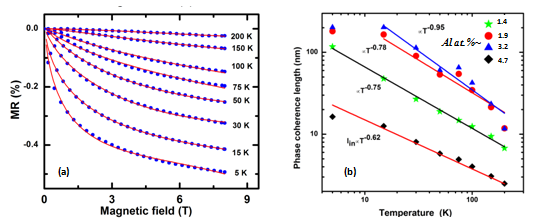
A clear signature of disorder induced quantum-interference phenomena leading to phase-coherent electron transport was observed in (Zn, Al)Ox thin films grown by atomic layer deposition. The degree of static-disorder was tuned by varying the Al concentration through periodic incorporation of Al2O3 sub-monolayer in ZnO during atomic layer deposition. All the films showed small negative magnetoresistance (MR) in the entire range of the measurement temperature (5-200K) and magnetic field (0-8T) due to magnetic field suppressed weak-localization effect as shown in a particular case of (Zn, Al)Ox with Al ~ 3.8 at.% in Figure 2 (a). The temperature dependence of phase-coherence length (lφ αT-3/4 ) extracted from the magnetoresistance measurements as shown in Figure 2 (b), indicated electron-electron scattering as the dominant dephasing mechanism. The persistence of quantum interference at relatively higher temperatures up to 200 K is promising for the realization of phase-coherent electron transport devices.
|
Figure 2 (a) Magnetic field dependent (0-8 T) MR of all the (Zn, Al)Ox thin films with 3.8 at.% Al at different temperatures in the range of 5-200K. The solid lines show the fitting of the experimental data (b) Variation of phase coherence length with temperature for all the (Zn, Al)Ox thin films with Al ~ 1.4, 1.9, 3.2, and 4.7 at.% |
|
|