 Photonic Materials Technology Section (PMTS)
Photonic & Detector Materials Laboratory (PDML)
Photonic Materials Technology Section (PMTS)
Photonic & Detector Materials Laboratory (PDML)
Crystal growth for photonic & radiation detection applications
1. Melt Growth of Single Crystals for Laser Host, Non-Linear Optical & Optical Memory Applications
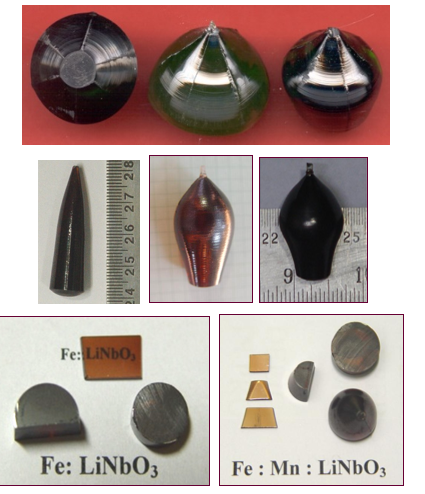
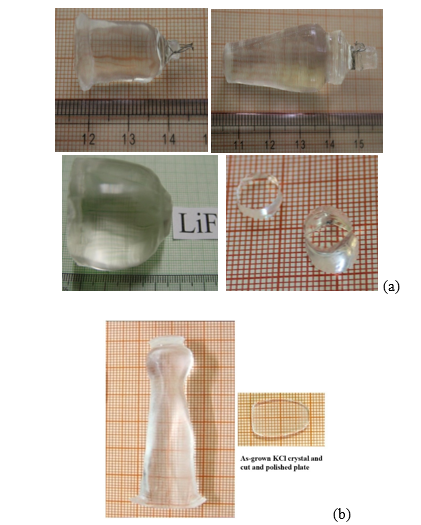
Crystals of congruent lithium niobate (CLN), undoped and doped lithium tetra borate (LTB), Lead tetraborate (PBO), Trans –stilbene (t-SB), Lithium fluoride (LiF), sodium chloride (NaCl) have been grown using Czochralski technique for laser host, frequency conversion and photorefractive memory applications. Some of the grown crystals are shown below.
Undoped and doped Lithium Niobate (LN)
|
Undoped and doped Lithium Niobate single crystals (top row) grown using Czochralski technique and the fabricated elements (bottom row) [Cryst. Growth Des. 8 (2008) 4424-4427; Cryst. Res. Technol. 44 (2009) 305-308; Cryst. Res. Technol. 44 (2009) 1303-1307] |
2. Crystal Growth for Radiation Dosimetry Applications
Undoped and doped Lithium Tetra Borate (LTB)
For radiation dosimetry applications:
- LTB crystals for personnel dosimetry in low dose environment
- Thermoluminescence (TL) is the thermally stimulated emission of light following the previous absorption of energy from radiation. LTB crystal has been used for the dosimetry applications.
For high power laser applications:
- Generating higher harmonics (3rd & 4th) of Nd:YAG laser
- High damage threshold (~40 GW/cm2) applications
|
Undoped and doped Lithium Tetra Borate single crystals (top row) grown using Czochralski technique and the fabricated elements (right image in bottom row) [Cryst. Growth Des. 8 (2008) 4424-4427; Cryst. Res. Technol. 44 (2009) 305-308; Cryst. Res. Technol. 44 (2009) 1303-1307] |
|
Thermoluminescence study of x-ray and gamma irradiated crystals as a function of dose. In addition, fading studies of doped and undoped lithium tetraborate crystals have been studied. Mass dependency of TL, Dose dependency of TL, Fading studies [Appl. Phys. Lett. 101 (2012) 071904; Radiation Measurements 67 (2014) 55-58; Physica B 456 (2015) 1-4] |
3. Crystal Growth for UV & IR Window Applications
Lithium fluoride
It possesses high UV transmission, being able to transmit significantly into the VUV region at the hydrogen Lyman-alpha line (121nm).
Potassium Chloride
Commonly used for optical components in wide spectrum band from the ultraviolet to the infrared, since KCl is transparent over the entire range of wavelengths (about 0.3 µm to 20 µm). It has low refractive index (1.454 at 10.6 µm) and high damage threshold. Potassium Chloride are particularly useful for windows in CO2 lasers.
|
Lithium Fluoride (a) and Potassium Chloride (b) single crystals grown using Czochralski technique |
4. Solution Crystal Growth for Non-Linear Optical Applications
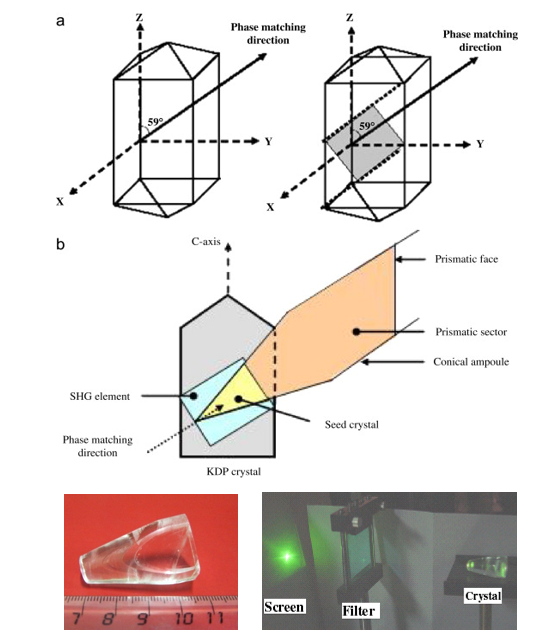
Phase matched direction-oriented growth of KDP crystal
Main advantage of the technique: Enables growth along technologically important directions leading to high device yield of the crystal.
|
Methodology of growing KDP crystal directly along phase matching direction using unidirectional technique, and the crystal grown directly along SHG direction with device yield of ~ 90 % and the test of SHG (green beam) output (Physica B 405 (2010) 1809-1812). |
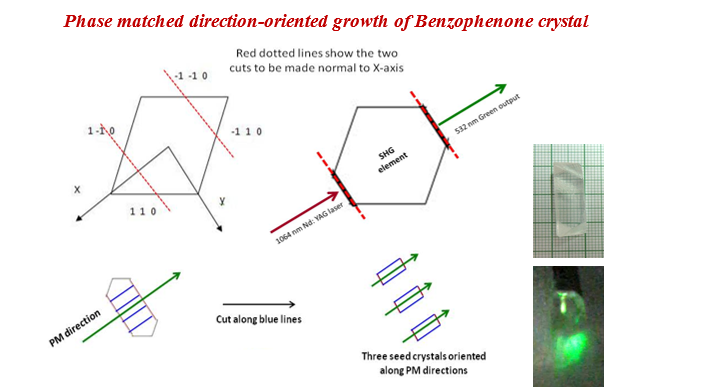
Phase matched direction-oriented growth of Benzophenone crystal
|
Crystal cutting procedure to obtain SHG element, frequency conversion confirmation and SHG direction-oriented seed crystals |
|
SHG oriented seed in ampoule and final unidirectionally grown Benzophenone crystal with SHG device yield of 90% [Proc. NLS-26 (2017), BARC Mumbai] |
5. Crystal Growth for Ferroelectric and Pyroelectric Applications
Polar direction oriented TGS crystals below phase transition temperature
|
Pure TGS, TGS doped with 70 mol% of L-Alanine, TGS doped with 5 wt % of Urea grown below Phase Transition temperature (< 49.3 °C) |
Polar direction oriented TGS crystals above phase transition temperature
|
Pure TGS, TGS doped with 70 mol% of L-Alanine, TGS doped with 5 wt % of Urea grown above Phase Transition temperature (> 49.3 °C)
[Appl. Phys. A 126 (2020) 492; J. Cryst. Growth 546 (2020) 125793; Mater. Res. Bull. 134 (2021) 111118; J. Mater. Sci.: Mater.in Electro., 32 (2021) 15778]
|
6. Organic Crystals for Scintillation based Radiation Detection
Radiation detection is crucial in various fields, including nuclear reactors, power plants, and border security. Radiation detectors commonly use scintillating materials that convert high-energy radiation (like gamma rays, x-rays and neutrons) into visible light detected by photodetectors. These materials come in various forms, including crystals, glasses, powders, ceramics, plastics, liquids, and gases. Scintillators fall into two main categories: inorganic and organic. Inorganic scintillators, often crystal-based, are used for detecting X-rays and gamma rays but are usually hygroscopic and hard to scale up. Organic scintillators, available in crystalline, liquid, plastic, and glassy forms, emit visible light when exposed to ionizing radiation and are ideal for radiation detection and large area detector applications.
Trans-stilbene (C6H5CH=CHC6H5)
Bridgman technique was used to grow trans-stilbene (TSB) single crystals for detection applications. Important properties of TSB are given below:
- Used for radiation detection and imaging
- Has applications in homeland security & defence
- High scintillation efficiency for fast neutrons (>1 MeV)
- Direct detection; No need of moderation to thermal energies
- Scintillation signal consists of prompt (gamma) and delayed fluorescence (neutrons)
- Superior PSD properties w.r.t. liquid & plastic scintillators
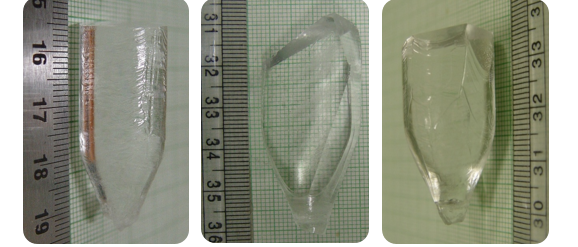
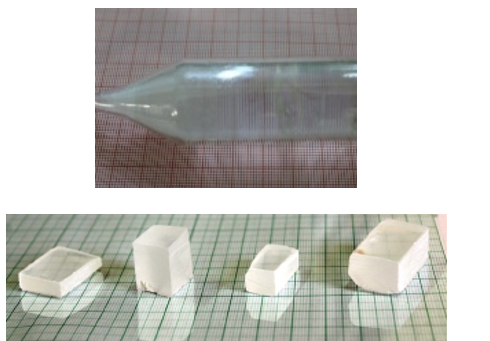
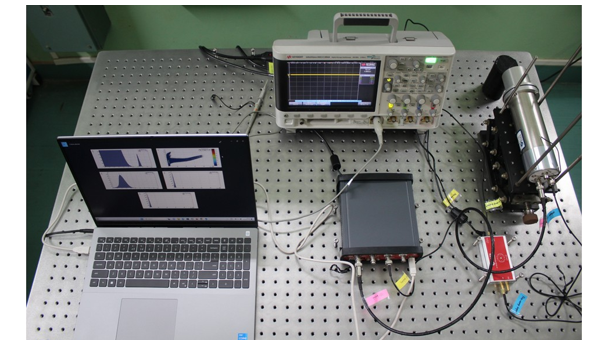
The grown crystals were stable, non-hygroscopic, and free from cracks, and were cut and polished for characterization. Powder XRD and interferometric characterization confirmed their crystalline phase and optical homogeneity respectively. A polished crystal plate of 2 mm thickness was 70% transparent in the UV-Vis range with UV cut-off at 356 nm, and had a band gap of 3.47 eV. Photoluminescence (PL) excited by 325 nm light showed a broad spectrum with a peak around 380 nm. Time-resolved PL studies revealed decay times of 1.98 ns and 4.14 ns. TSB crystals can distinguish neutrons from gamma radiation due to different scintillation decay times. The pulse shape discrimination (PSD) capabilities of the grown TSB crystals were tested. A detector set up has been developed for this purpose and PSD capabilities have been characterized.
|
|
Trans-Stilbene single crystal grown using Bridgman technique and the fabricated element for radiation detector applications
|
|
|
Scintillation materials characterization set up including PSD
|
|
|
Pulse Shape Discrimination of mixed radiation & corresponding histogram of counts vs PSD
[IEEE Trans. Nuclear Science, 71 (11) (2024) 2432-2441]
|
|
Blue emission from x-ray irradiated trans-silbene crystal
[J Mater Sci: Mater Electron 36, 793 (2025)]
|







![Undoped and doped Lithium Tetra Borate single crystals (top row) grown using Czochralski technique and the fabricated elements (right image in bottom row) [Cryst. Growth Des. 8 (2008) 4424-4427; Cryst. Res. Technol. 44 (2009) 305-308; Cryst. Res. Technol. 44 (2009) 1303-1307]](crys_grow_2.png)
![Thermoluminescence study of x-ray and gamma irradiated crystals as a function of dose. In addition, fading studies of doped and undoped lithium tetraborate crystals have been studied. Mass dependency of TL, Dose dependency of TL, Fading studies [Appl. Phys. Lett. 101 (2012) 071904; Radiation Measurements 67 (2014) 55-58; Physica B 456 (2015) 1-4]](crys_grow_3_v2.png)
![SHG oriented seed in ampoule and final unidirectionally grown Benzophenone crystal with SHG device yield of 90% [Proc. NLS-26 (2017), BARC Mumbai]](crys_grow_7.png)
![Pure TGS, TGS doped with 70 mol% of L-Alanine, TGS doped with 5 wt % of Urea grown above Phase Transition temperature (> 49.3 °C)
[Appl. Phys. A 126 (2020) 492; J. Cryst. Growth 546 (2020) 125793; Mater. Res. Bull. 134 (2021) 111118; J. Mater. Sci.: Mater.in Electro., 32 (2021) 15778]](crys_grow_9.png)
![Pulse Shape Discrimination of mixed radiation & corresponding histogram of counts vs PSD
[IEEE Trans. Nuclear Science, 71 (11) (2024) 2432-2441]](crys_grow_12.png)
![Blue emission from x-ray irradiated trans-silbene crystal
[J Mater Sci: Mater Electron 36, 793 (2025)]](crys_grow_13.png)


