| Photonic Materials Technology Section (PMTS) |
 Photonic Materials Technology Section (PMTS)
Nano-Electronic Materials and Devices Laboratory
Photonic Materials Technology Section (PMTS)
Nano-Electronic Materials and Devices Laboratory
Memristive and Chemiresistive Gas sensors
Highly sensitive and selective gas sensing systems with fast response are essential for applications including environmental monitoring, breath-based diagnostics, electronic nose for detection of toxic/explosive gases like H2/NH3 etc. The high working temperature of these gas sensors not only restricts its integration but also lead to ignition of flammable gases, which limits the application potential of metal oxide gas sensors to a large extend. Room temperature ammonia gas sensors are crucial as these sensors eliminate the need for external heating, reducing energy consumption and safety risks associated with high temperatures making it reliable for real-time monitoring. Various metal oxide semiconductors such as SnO2, TiO2, ZnO, WO3, CuO etc., and their nanostructures with different morphologies have been used for H2/NH3 sensing. Among these, ZnO nanostructures are preferred due to their excellent sensing response, good thermal and chemical stability, low cost, easy preparation, and non-toxicity.
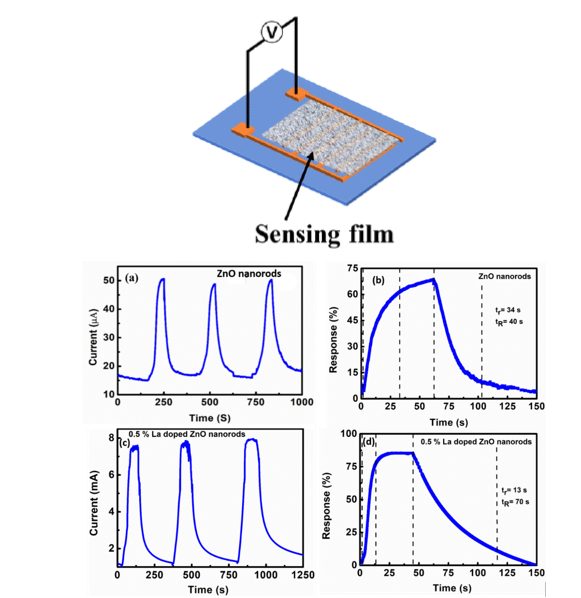
We have fabricated room temperature Zinc Oxide (ZnO) nanorods based ammonia gas sensor and enhanced its performance using Lanthanum (La) doping. Indium Tin Oxide (ITO) inter-digitated electrodes (IDE) were fabricated on glass substrates via UV photolithography. ZnO nanorods were synthesized on ZnO-seeded ITO IDE substrates via hydrothermal growth process using hexamethylenetetramine and zinc nitrate hexahydrate as precursors. To improve gas sensor response, 0.5% La doping was done by incorporating lanthanum chloride heptahydrate into the ZnO nanorods. The 0.5 % La doping in ZnO nanorods increases the sensor response from ~67 to 85 % with decrease in response time from ~ 34 to ~ 13 secs. The low-cost, biocompatible, and compact ZnO-based ammonia gas sensors with high responsivity demonstrate immense potential for room temperature ammonia sensing applications.
In recent years, “chemi-memristive gas sensors”, an integration of gas sensors and neuromorphic engineering technologies, has shown immense potential in mimicking human olfactory system mainly for artificial intelligence systems. Among various gas sensors, being an energy carrier, H2 sensing well below its explosive limit (4% in air) is essential in rockets, atomic energy welding's, and petroleum. Also, gas sensors of H2 and NH3 play an important role in the safety of heavy water plants (D2O). Highly sensitive and selective H2 and NH3 gas sensing systems with fast response at room temperature are essential for aforesaid applications with specific direction towards chemi-memristive device based artificial olfactory systems.
|
Gas sensing response of undoped and 0.5 % La doped ZnO nanorods under 250 ppm NH3 |
|
|