 Photonic Materials Technology Section (PMTS)
Nano-Electronic Materials and Devices Laboratory
Photonic Materials Technology Section (PMTS)
Nano-Electronic Materials and Devices Laboratory
Nanogenerators for Vibration Energy Harvesting
The depletion of fossil fuels and reduction of non-renewable energy sources have underscored the urgent need for sustainable energy alternatives. With the expanding Internet of Things (IoT), wearable electronics, wireless networks, cloud processing and implantable medical devices, there is a growing demand for reliable power sources that overcome the limitations of Li-ion batteries, such as finite lifespan and environmental disposal concerns. Nanogenerators, which convert ambient vibration energy from sources like wind, footsteps, water waves, and industrial machinery emerged as a sustainable solution for powering micro- and nanoelectronics devices. Piezoelectric and triboelectric nanogenerators are two promising devices for harvesting ambient mechanical energy. Piezoelectric nanogenerators works on the principle direct piezoelectric effect, generating voltage upon the application of stress, whereas triboelectric nanogenerators rely on charge transfer through contact electrification between two materials. Zinc oxide (ZnO) is widely used in piezoelectric nanogenerator fabrication due to its lead-free, semiconducting properties, tunable n-type conductivity, and chemical and thermal stability, cost-effective and compatible with low-temperature synthesis. Additionally, ZnO owing to n-type conductivity with wide bandgap, and structural adaptability at the nanoscale is a potential candidate as tribopositive material for triboelectric nanogenerators.
Piezoelectric nanogenerators
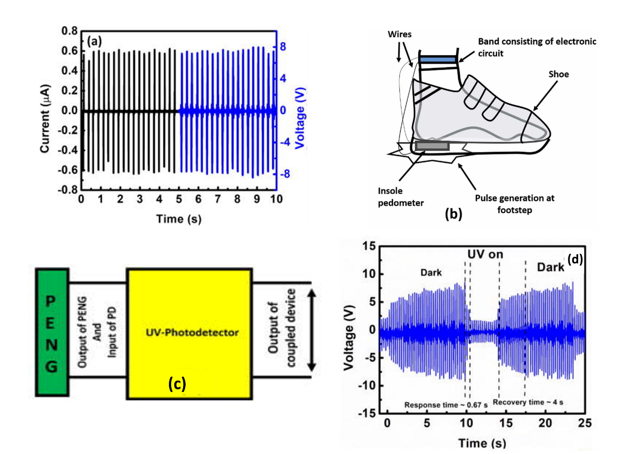
A ZnO:PVDF freestanding piezoelectric nanogenerator (PENG) was fabricated by incorporating hydrothermally grown ZnO nanorods into a PVDF matrix, sandwiched between Aluminium electrodes. As shown in Fig. 1(a), the optimized ZnO:PVDF PENG, with 10 wt% ZnO, achieved peak output values of ~14.6 V open-circuit voltage and ~0.6 µA short-circuit current with an instantaneous power density of ~21.3 µW/cm² under a 30 N periodic force at 4 Hz. This enhancement was attributed to interactions between ZnO polar facets and the –CH₂ and –CF₂ groups in PVDF, promoting β-phase crystallization confirmed by XRD and FTIR. The optimized PENG was integrated into a shoe insole pedometer (Fig. 1(b)) and interfaced with an Android app via Bluetooth, showing ~99% accuracy over 5,000 steps at walking speeds of 1.4–5.5 km/h. Furthermore, a ZnO-based metal-semiconductor-metal (MSM) UV photodetector was coupled with the PENG for a self-powered UV sensor through impedance matching, as shown in Fig. 1(c). The resistance of photodetector dropped from ~55 MΩ in darkness to 2 MΩ at UV intensities up to 14.5 mW/cm², aligning with the output range of PENG. At ~1.5 mW/cm² UV exposure, the output voltage of coupled device dropped from ~14.6 V to 3.88 V, reaching ~1.04 V at 14.5 mW/cm². The self-powered UV sensor exhibited a sensitivity of ~93%, responsivity of 7.14 V/(mW•cm⁻²), response time of ~0.67 s, and recovery time of ~4 s, as shown in Fig. 1(d).
|
Figure 1: (a) Output characteristics of ZnO:PVDF piezoelectric nanogenerator (b) Schematic of integration of ZnO:PVDF piezoelectric nanogenerator as insole pedometer sensor (c) coupling of ZnO:PVDF piezoelectric nanogenerator (PENG) with UV photodetector for self-powered UV sensing (d) Transient output of self-powered UV sensor. |
Triboelectric nanogenerators
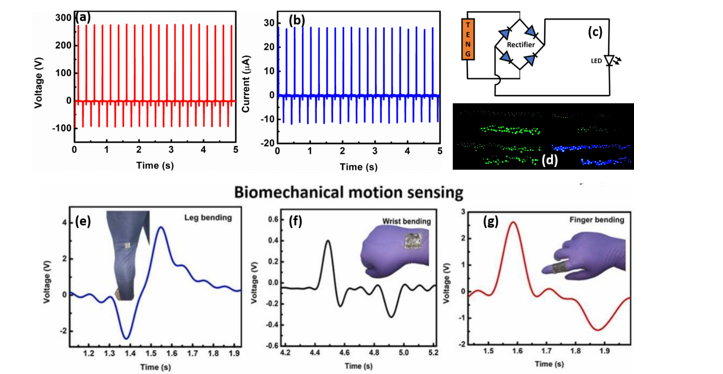
A contact-separation mode triboelectric nanogenerator (TENG) was fabricated using ZnO as a tribopositive layer and PDMS as a tribonegative layer. ZnO was deposited on an ITO-coated PET substrate using RF magnetron sputtering at room temperature, while PDMS was spin coated over ITO-coated PET substrate. The as fabricated TENG showed an open-circuit voltage of ~112 V and a short-circuit current of ~7.8 µA under a periodic force of 30 N at 4 Hz. 1% Aluminium doping in ZnO (AZO) increased electron concentration, improved the output TENG to ~210 V and ~18 µA. To prevent carrier loss required for triboelectricfication from AZO to ITO, an SiO2 interlayer of 100 nm was introduced at the interface of AZO and ITO enhancing output to ~288 V and ~25.8 µA. Incorporating MoS₂ nanoflowers into the PDMS matrix created a nanocapacitor network, further increasing charge holding capacity of PDMS and improved the output to ~369 V and ~28.3 µA, achieving a power density of ~1.8 mW/cm² (Fig. 2(a,b)). The rectified output of as fabricated TENG using rectifier circuit shown in Fig. 2(c) was able to power 400 LEDs without an external storage device as shown in Fig. 2(d). Furthermore, a single-electrode TENG (STENG) was developed by coating a MoS₂:PDMS composite on Cu-Ni coated textile showing ~320 V and ~33 µA with a power density of ~3.2 mW/cm² under periodic hand tapping. The STENG was used as a self-powered biomechanical motion sensor, detecting motions like wrist (~0.9 V), finger (~4 V), and leg bending (~6.5 V), each with distinct voltage signatures (Fig. 2(e,f,g)).
|
Figure: (a) Open-circuit voltage, (b) short-circuit current characteristics of as-fabricated TENG, (c) Rectifier circuit used to directly (d) power 400 serially connected LEDs and (e) Open-circuit voltage characteristics upon leg bending, (f) wrist bending and (g) Finger bending |