 Photonic Materials Technology Section (PMTS)
Ferroelectric and Scintillator Materials Laboratory
Photonic Materials Technology Section (PMTS)
Ferroelectric and Scintillator Materials Laboratory
Scintillators and Transparent Ceramics
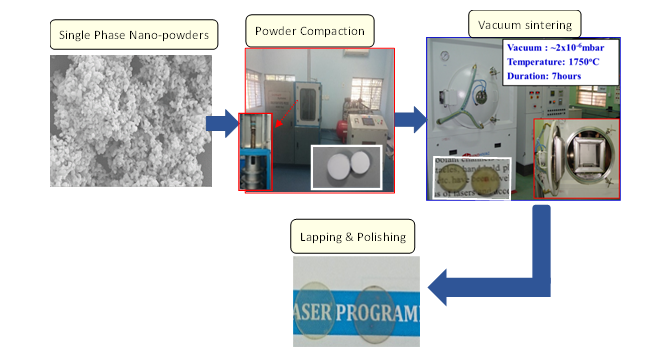
Transparent ceramics play a crucial role in advanced optical applications, particularly as laser host materials and scintillators. In our laboratory, we focus on rare earth-doped YAG (yttrium aluminum garnet) ceramics, which have demonstrated great promise due to their optical transparency, robustness, and suitability for a variety of high-performance devices. The transparent ceramics have clear advantages over single crystals, such as easier and more scalable fabrication methods, superior mechanical strength, and the ability to produce larger and more complex shapes without the constraints faced by single crystal growth. But achieving the required level of optical transparency remains a significant challenge. Factors such as grain boundary scattering, porosity, and dopant homogeneity can hinder the transpare, ty. The conventional solid-state reaction route is insufficient for the successful fabrication of these transparent ceramics. Instead, the synthesis of nanoparticles via chemical routes is essential. This process is followed by compaction and vacuum sintering, which collectively facilitate the production of high-quality transparent YAG-based ceramic.
|
Fig. 1 Journey for Transparent YAG ceramic |
Rare earth-doped YAG ceramics are of significant interest due to their applications in solid-state lasers, where they serve as active media that convert electrical energy into laser light. Additionally, their scintillating properties make them valuable for detecting ionizing radiation in medical imaging, security, and nuclear industries. In recent years, we have expanded our research efforts to include rare-earth-doped YAG (yttrium aluminum garnet) ceramics, which are gaining prominence for their critical roles in laser hosts and scintillator applications.
Our laboratory is deeply engaged in fundamental research to address challenges associated to the fabrication of transparent ceramics. We investigate the effects of various synthesis and processing techniques, compositional inhomogeneity, dopant concentrations, and sintering conditions to overcome issues like light scattering, inclusions, and grain boundary defects. Below are some highlights from our recent findings:
|
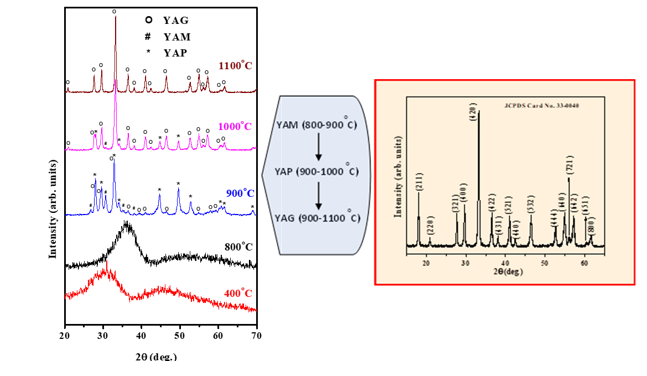
Fig. 2 Phase formation sequence of YAG based ceramics prepared by co-precipitation method |
|
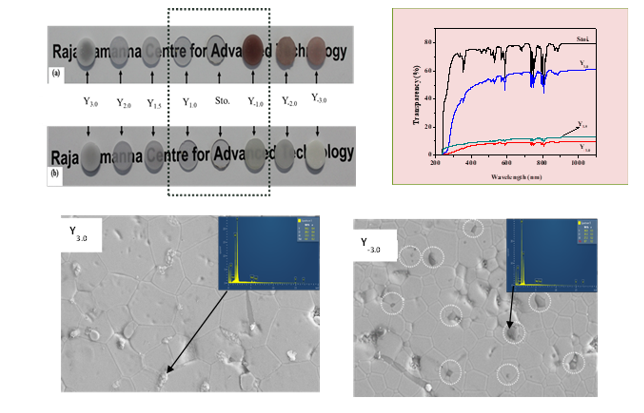
Fig. 3 Effect of secondary phase on transparency of Nd doped YAG |
|
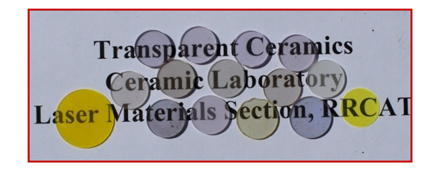
Fig. 4 Photo graph of some transparent ceramics fabricated in FSML, RRCAT |
|
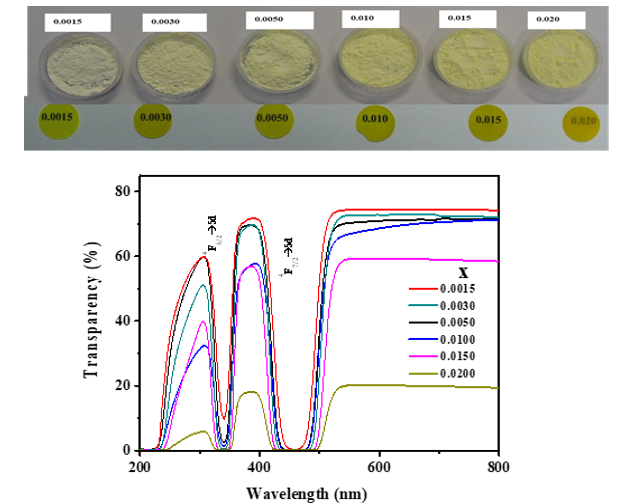
Fig. 5 Fabrication of cerium doped YAG i.e. (Y1-xCex)3Al5O12 transparent ceramics |
|
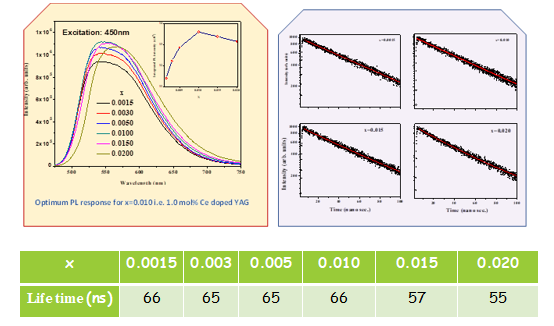
Fig. 6 Dependence of PL and life time on cerium content in Ce:YAG transparent ceramics |
|
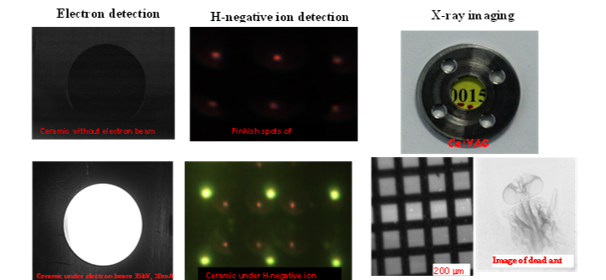
Fig. 7 Detection of electron, H-negative ion and X-ray imaging using Ce:YAG ceramic |