| Photonic Materials Technology Section (PMTS) |
 Photonic Materials Technology Section (PMTS)
Nano-Electronic Materials and Devices Laboratory
Photonic Materials Technology Section (PMTS)
Nano-Electronic Materials and Devices Laboratory
Resistive Switching Devices and Artificial Synapse
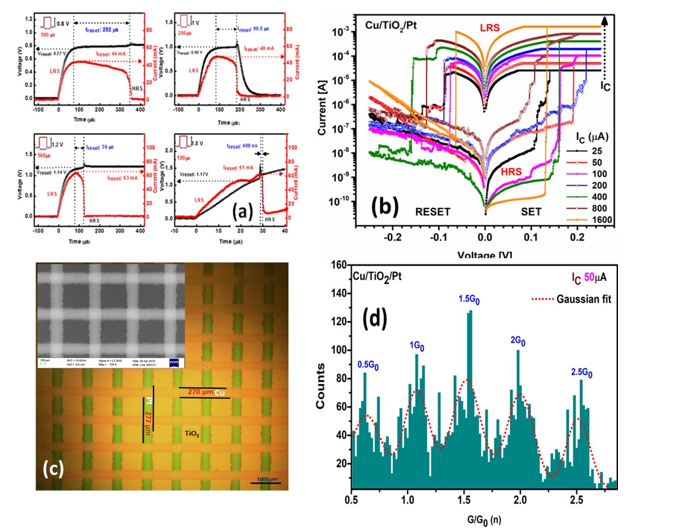
This study investigates TiO2-based resistive random-access memory (RRAM) devices optimizing their switching characteristics for scalable, low-power memory applications. Devices fabricated using different electrode materials, including noble metals (Au, Pt) and cost-effective alternatives like titanium nitride (TiN) were studies in both unipolar and bipolar configurations. Unipolar resistive switching was demonstrated in Au/TiO2/Pt devices fabricated by atomic layer deposition (ALD) and RF sputtering. These devices showed reliable endurance (~1000 cycles), long retention (~10⁴ seconds), consistent reset (~0.6 V) and set (~2.5V) voltages and minimal variability (~20%). However, the reset switching time (~250 μs) was relatively high in comparison to set time (~180 ns). Notably, increasing the amplitude of reset voltage pulse from 0.8 V to 1.8 V, reduced the reset time to ~400 ns, but further improvements in power efficiency were needed for low-power applications. To address the high-power consumption (~10 mW) in unipolar configurations, we developed Cu/TiO2/Pt devices by replacing the Au top electrode with oxidisable Cu. This configuration yielded bipolar switching with significantly reduced reset (-0.1 V) and set voltages (+0.2 V) and reset currents (~10 µA), enabling low-power operations (~µW) and with ~250 ns of switching times it resulted in low-energy switching (~pJ). In addition to standard resistive switching, we also demonstrated 3-bit multilevel resistive switching in Cu/TiO2/Pt devices by controlling compliance current (IC), producing multiple distinct low-resistance states and a high-resistance state. Furthermore, TiN electrodes fabricated via RF sputtering were explored as a cost-effective alternative to Pt, showing similar switching behaviors and improved resistivity with optimized nitrogen pressure and substrate temperatures during deposition. The TiN-based devices performed comparably to Pt-based configurations, with similar endurance and retention characteristics.
To further enhance the integration density, Cu/TiO2/Pt devices in an 8 × 8 crossbar configuration were fabricated with cell sizes of ~270µm × 270µm. The devices displayed reliable bipolar switching with excellant device-to-device and cycle-to-cycle variability and stable retention over 10³ seconds. The set and reset voltages ranged from +0.59 to +1.34 V and -0.24 to -0.71 V, with low coefficient of variation (15.41% and 20.92%, respectively). Additionally, half-integral quantized conductance (QC) was observed during the reset process, attributed to the gradual rupture of Cu-based conductive filaments (CF). By increasing IC from 50 µA to 800 µA, the QC magnitude increased from 2.5 to 12.5 conductance units, with the number of QC steps increasing from 5 to 18. This phenomenon was attributed to CF diameter variation, estimated to increase from ~1.2 nm to ~3.3 nm with rising IC, offering tunable memory density and potential applications in neuromorphic computing. The resistive switching mechanisms were elucidated using the CF model. In unipolar Au/TiO2/Pt devices, switching was attributed to oxygen vacancy-based thermal dissolution. The bipolar resistive switching in Cu/TiO2/Pt and Cu/TiO2/TiN devices was explained through electrochemical metallization of Cu CFs. Impedance spectroscopy characterisations supported the filamentary nature of switching, showing that the resistive contribution in LRS and HRS arose from the connected CF and rupture gap resistance, respectively, whereas capacitive contributions were dominated by the surrounding TiO2 matrix rather than the rupture gap. This study demonstrates the potential of TiO2-based RRAM with both unipolar and bipolar switching configurations, achieving high-density and low-power operation. The quantized conductance effect in crossbar geometries enables further control over memory states, positioning these devices as promising candidates for scalable, energy-efficient memory applications and neuromorphic computing.
|
(a) Decrease in RESET switching speed of Au/TiO2/Pt ReRAM devices on increasing RESET voltage, (b) bipolar resistance switching, (c) optical and SEM (inset) image, and (d) quantized conductance of Cu/TiO2/Pt ReRAM devices |
|
|