| Photonic Materials Technology Section (PMTS) |
 Photonic Materials Technology Section (PMTS)
Nano-Electronic Materials and Devices Laboratory
Photonic Materials Technology Section (PMTS)
Nano-Electronic Materials and Devices Laboratory
High K Dielectrics for Electrostatic Energy Storage
Current approach towards scaling the metal–insulator–metal (MIM) capacitors is to replace the conventional SiO2 by alternate high-k dielectric layers to achieve higher capacitance density, reduced feature size, and low standby power. Multi-layered nanolaminates (NLs) of two high-k oxide dielectrics with conductivity contrast have emerged as an attractive candidate for this application. Among others, Al2O3/TiO2/Al2O3 (ATA) NLs containing alternatively stacked ultrathin layers of TiO2 and Al2O3 is promising due to the high dielectric constant owing to Maxwell-Wagner (M-W) relaxation, excellent thermal stability, and low leakage. ATA NLs have been fabricated and studied for their dielectric and electrical properties for energy storage applications.
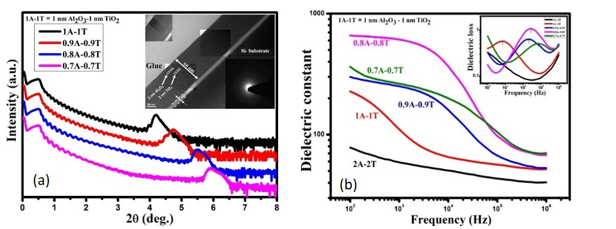
Amorphous ATA NLs were deposited by pulsed laser deposition on TiN/Si and Si substrates at 300 °C in O2 pressure of 0.01 mbar. A KrF excimer laser at laser energy density ~ 0.5 J /cm2 and pulse repetition rate of 5 Hz was used for ablation. The average growth rates of TiO2 and Al2O3 films were in the range of ~0.009 and 0.005 nm per pulse. The sublayer thicknesses were reduced from ~2 to 0.7 nm in different NLs while keeping the total thickness constant at ~ 60 nm. The TiN/ATA/TiN capacitor structures were fabricated by depositing TiN top electrodes by RF-magnetron sputtering. The thickness and diameter of the top TiN electrodes were ~150 nm and 220 µm, respectively. X-ray reflectivity measurements on these multilayers with intense Bragg peaks, as shown in Figure 1 confirmed the superlattice structures with extremely uniform thickness and chemically and physically sharp interfaces. TEM image of the ATA NL with sublayer thicknesses of ~ 2 nm (inset of Figure 1) revealed well-defined layer structure with ~3.94 nm periodicity, abrupt interface and long-range thickness uniformity of sublayers.
The dielectric constant and loss of ATA-NLs studied through impedance spectroscopy in frequency range of 1–106 Hz is shown in Figure 1(b). It can be seen that the dielectric constant of ATA NLs increased from 60 to 660 with decreasing sublayer thicknesses of Al2O3 and TiO2 from ~ 2 to 0.8 nm then reduced to ~380 for sublayer thicknesses of ~0.7 nm. A step like increase in dielectric constant forming a plateau region towards lower frequency side was clearly observed when the sublayer thickness is ≤1.0 nm. The highest dielectric constant of ~ 660 obtained for nanolaminate with 0.8 nm sublayer thickness is significantly larger than that of both Al2O3 (K ~10) and TiO2 (K ~ 40) dielectrics. The dielectric loss in all ATA NLs was <1 as shown in inset of Figure 1(b).
|
Figure 1: (a) Measured XRR spectra for ATA NLs, inset shows TEM micrograph of 0.8A-0.8T NL, (b) dielectric constant of ATA NLS with frequency, inset shows loss as a function of frequency. |
The origin of observed high dielectric constant in ATA NLs was proposed to be due to M-W type dielectric relaxation caused by space charge polarization across the interfaces of NLs. When ac signal is applied across NL with different individual layer conductivity, surface charges accumulate at their interfaces resulting in an interfacial relaxation called M-W relaxation, which is a typical external contribution to the dielectric constant. Temperature dependent dispersion in real and imaginary impedance (Z’ and Z’’) of ATA NL with sublayer thicknesses of ~ 0.8 nm (0.8A-0.8T), clearly indicated existence of two sets of relaxations, both being thermally activated, confirming existence of interfacial M-W relaxation. The 0.8A-0.8T ATA NL showed high cut-off frequency of ~ 105 Hz along with low dielectric loss of ~ 0.17, and low leakage current density of ~ 10-5 A/cm2 which further reduced to ~ 0.03 at 100 Hz and ~10-7 A/cm2 at 1 V by sandwiching ATA NL between ~ 3 nm thick Al2O3 layer. A high capacitance density of 19 fF/μm2, low EOT of ~1 nm, small quadratic voltage coefficient of capacitance α ~ 85 ppm/V2 and linear coefficient β of ~263 ppm/V, together with a temperature coefficient of 81 ppm/°C and breakdown field of 1.13 MV/cm make ATA NL based MIM capacitors as promising candidate for next generation energy and data storage applications.
|
|