| Photonic Materials Technology Section (PMTS) |
 Photonic Materials Technology Section (PMTS)
Optical and Glass-Ceramic Laboratory
Photonic Materials Technology Section (PMTS)
Optical and Glass-Ceramic Laboratory
Glass-Ceramic based Electric feed-through
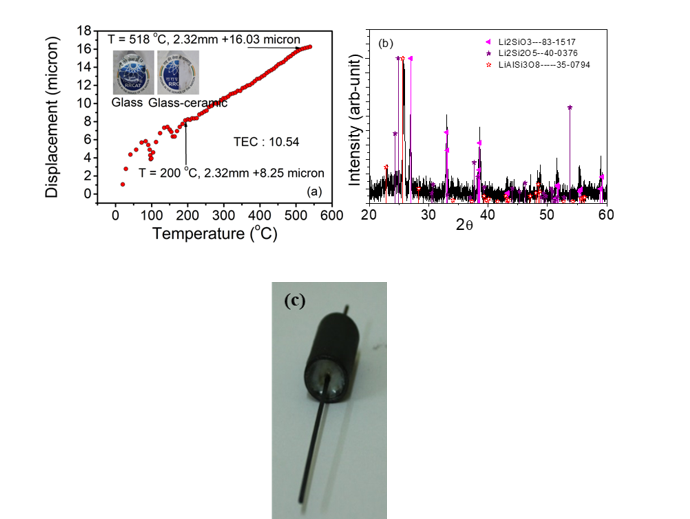
Glass-ceramics offer an alternative route to brazing for fabricating UHV-compatible hermetically sealed ceramic-ceramic and ceramic-metal joints without recourse to metallization. Lithium aluminum silicate (LAS) based glass ceramic was developed and a single pin electric feedthrough is fabricated. Fabrication of electrical feed-through (Figure 1) comprises: preparation of suitable graphite jigs and fixtures, chemical cleaning of type 304L SS tube and pin followed by their decarburization, assembly of SS tubes, pins and glass-ceramic powder inside SS tube-pin assembly followed by the optimized heat treatment.
Materials fabricated: Lithium aluminum silicate (LAS)
Dimensions:
- SS tube, Diameter= 10 mm; Thickness = 1.0 mm; Length = 20 mm
- SS pin, Diameter = 1.2 mm, Length = 70 mm
Fabrication method: Glass ceramic route
Properties:
- Phase: Lithium silicate and lithium aluminum silicate
- Leak rate: helium leak rate less than 2 x 10⁻¹⁰ mbar lit/sec
- Thermal Expansion Coefficient: 10.54 x 10⁻⁶ /°C (temperature range 200 to 600 °C)
- Thermal Endurance: 5 thermal cycles of heating and cooling up to 150 °C for 48 hours and 5 thermal cycles of heating and cooling up to 250 °C for 24 hours
- Electric breakdown: no breakdown up to 2.3 kV
|
Figure 1: Single pin electric feedthrough fabricated using glass ceramic route having thermal expansion coefficient (a) and phase present in the glass (b). The final single pin electric feedthrough is shown in (c) |
|
|