 Photonic Materials Technology Section (PMTS)
Ferroelectric and Scintillator Materials Laboratory
Photonic Materials Technology Section (PMTS)
Ferroelectric and Scintillator Materials Laboratory
Ferroelectric Materials
Ferroelectrics play a crucial role in a variety of applications, particularly as actuators and sensors due to their unique electric polarization properties. Our research primarily concentrates on the development of Barium titanate (BaTiO3) and sodium bismuth titanate (NBT) based lead-free ferroelectric materials. We aim to understand the structure-property relationships that can enhance piezoelectric responses, which are vital for improving the performance of devices. While we are advancing lead-free materials, we also continue to utilize traditional materials like PZT (Lead Zirconate Titanate) for both applications and foundational research.
|
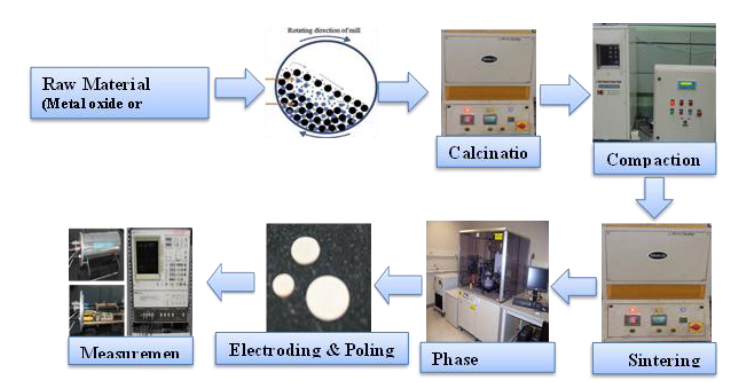
Fig.1 Layout for synthesis of ferroelectric ceramics by solid state reaction route |
1. Lead-free ferroelectrics
This activity is dedicated to advancing the field of lead-free ferroelectric ceramics, with a primary focus on NBT (sodium bismuth titanate) and BT (barium titanate) based materials. The motivation for our research lies in addressing environmental and health concerns associated with traditional lead-based ferroelectric ceramics, such as PZT (lead zirconate titanate), by developing sustainable alternatives without compromising functional properties. Our research emphasizes the structure-property correlation of these lead-free materials. By investigating the relationship between crystal structure, and macroscopic properties such as dielectric, piezoelectric, and ferroelectric behavior, we aim to optimize material performance for a variety of applications, including sensors, actuators, and energy harvesting devices.
Through a combination of experimental techniques—such as X-ray diffraction (XRD), scanning electron microscopy (SEM), and electrical characterization—we systematically study the effects of compositional modifications, phase transitions, and domain structure on the piezoelectric/ferroelectric properties of NBT and BT-based ceramics. This approach enables us to contribute valuable insights toward the development of environmentally friendly ferroelectric materials with tailored properties for specific technological applications.
In addition to structure-property studies, our laboratory has recently initiated research on the correlation between piezoelectric and photo-luminescent properties in rare earth-doped NBT ceramics. This novel approach aims to explore multifunctional behavior, which could lead to new applications in optoelectronics and smart sensing technologies. Some of our research outcome includes:
|
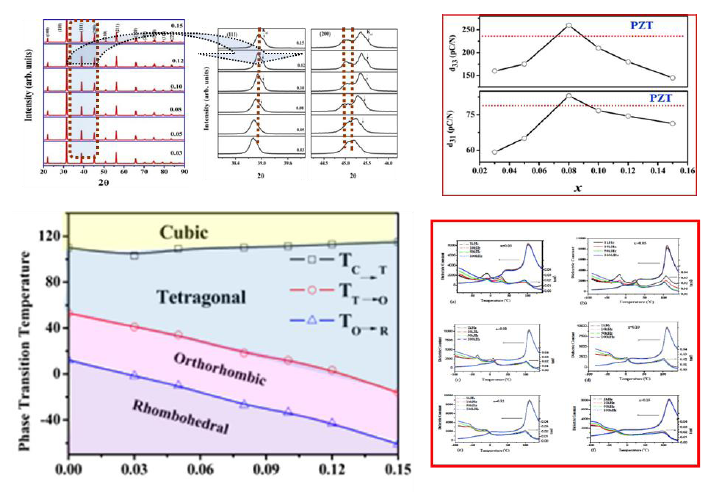
Fig.2 Structure property correlation in (Ba1-xCax )(Zr0.05Ti0.95)O3 |
|
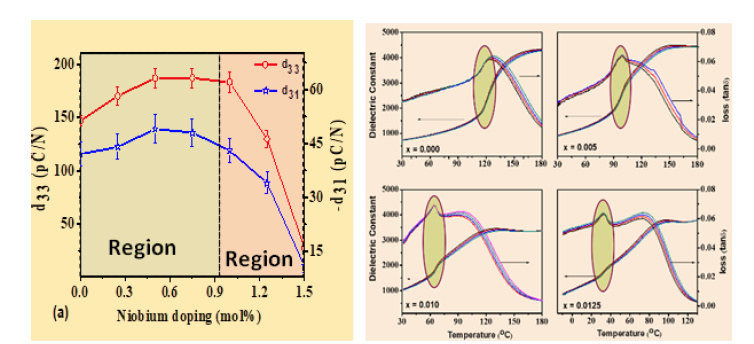
Fig. 3 Piezoelectric & Dielectric response of (Na0.41K0.09Bi0.50)1-x/2(Ti1-xNbx)O3 |
|
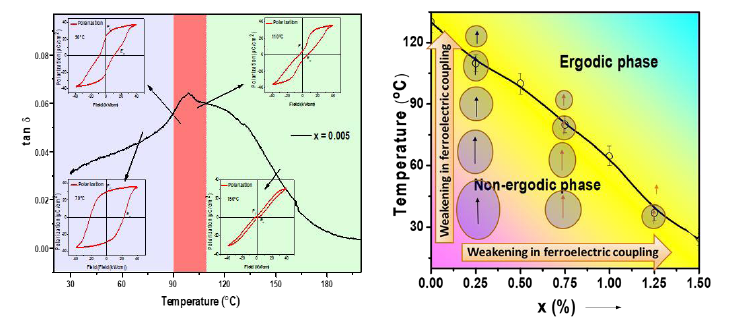
Fig. 4 A correlation between piezoelectric and dielectric response with depolarization temperature of (Na0.41K0.09Bi0.50)1-x/2(Ti1-xNbx)O3 |
2. PZT based ferroelectric
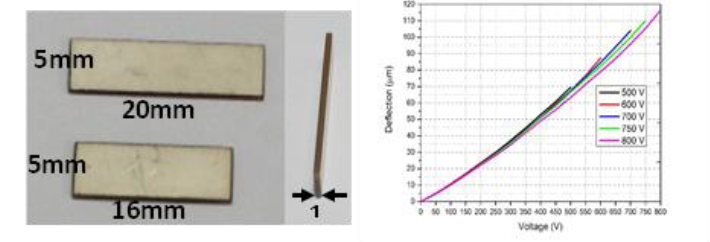
While the focus on lead-free piezoelectric materials is critical for addressing environmental concerns and regulatory requirements, Pb(Zr0.52Ti0.48)O3 [PZT] continues to be a cornerstone in the field of piezoelectric materials due to its unique properties. Our laboratory is dedicated to understanding the unique characteristics of PZT, exploring its performance in various applications, and investigating ways to enhance its properties through innovative processing techniques. At the Raja Ramanna Centre for Advanced Technology (RRCAT), we specialize in preparing PZT tailored specifically for ultrasonic, actuator and energy harvesting applications. Our focus on meeting the unique needs of our users at RRCAT. Some of the notable outcomes of our PZT processing efforts include
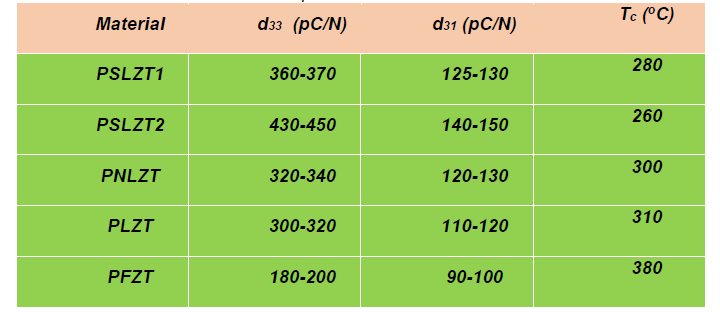
Table-1 : Piezoelectric strain coefficient and Curie temperature for few PZT based piezo-electrics
|
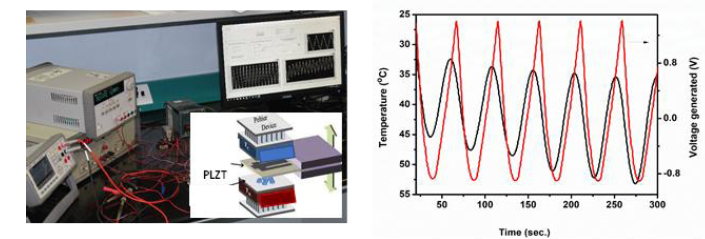
Fig. 5 Energy Harvesting for PZT based ceramics |
|
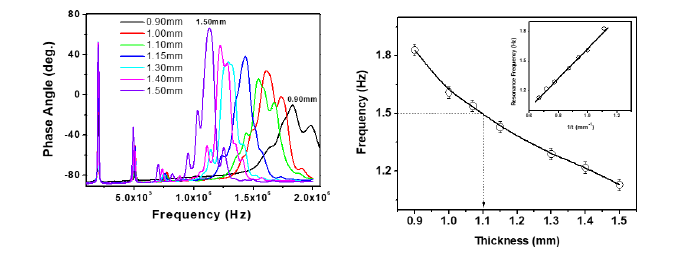
Fig. 6 Variation of thickness mode resonance frequency of PZT based ceramic with thickness |
|
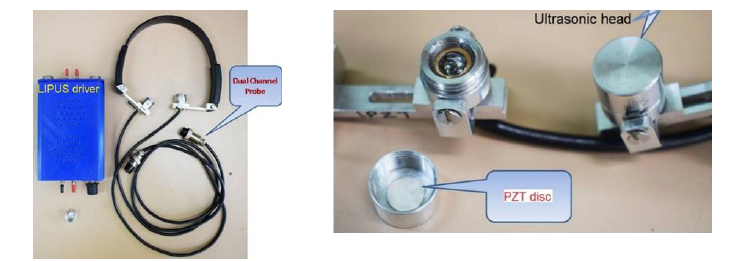
Fig. 7 Module for low intensity ultrasound generation developed at RRCAT using PZT based piezo-electric discs |
|
Fig. 8 PZT based ceramic tested for unimorph actuator at RRCAT |